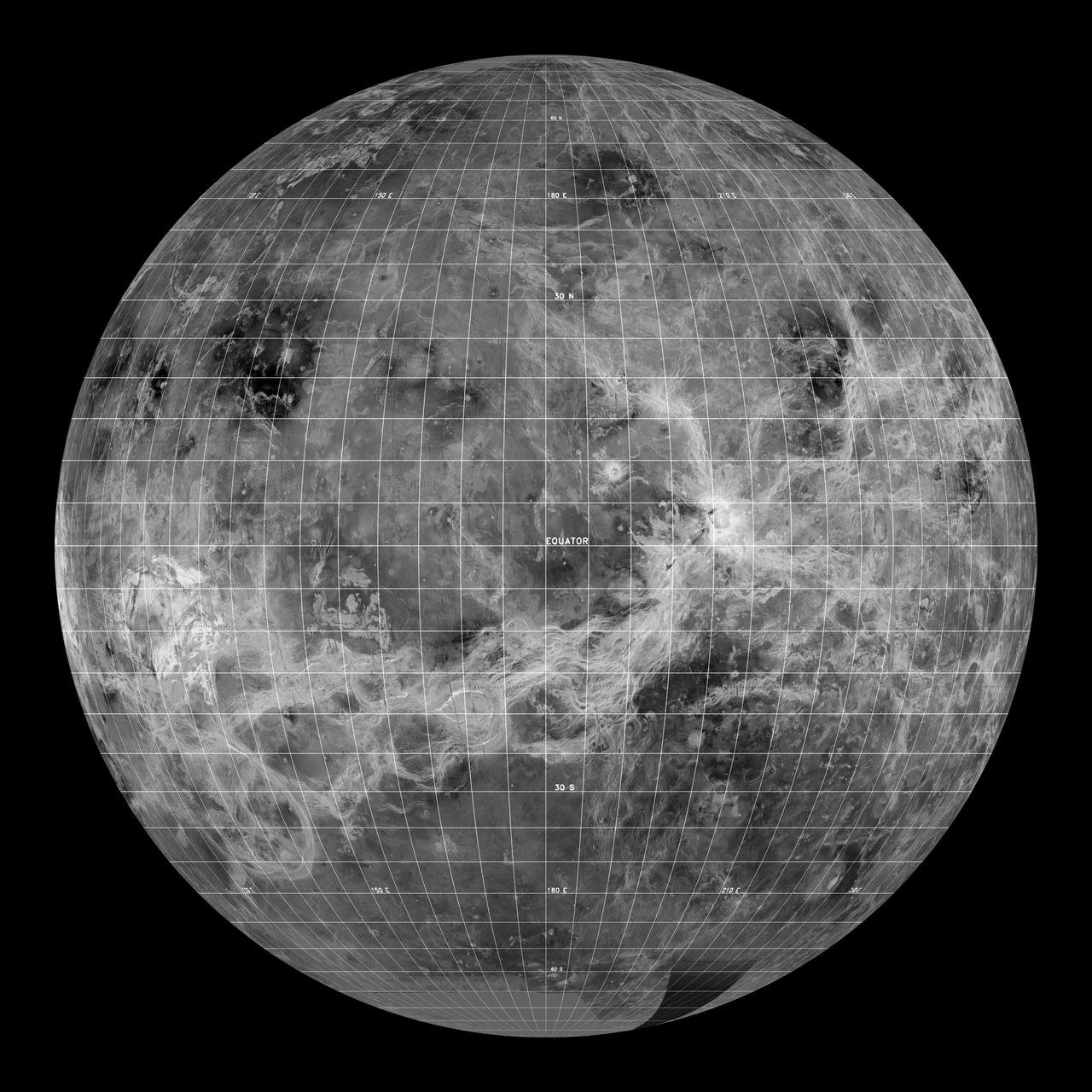
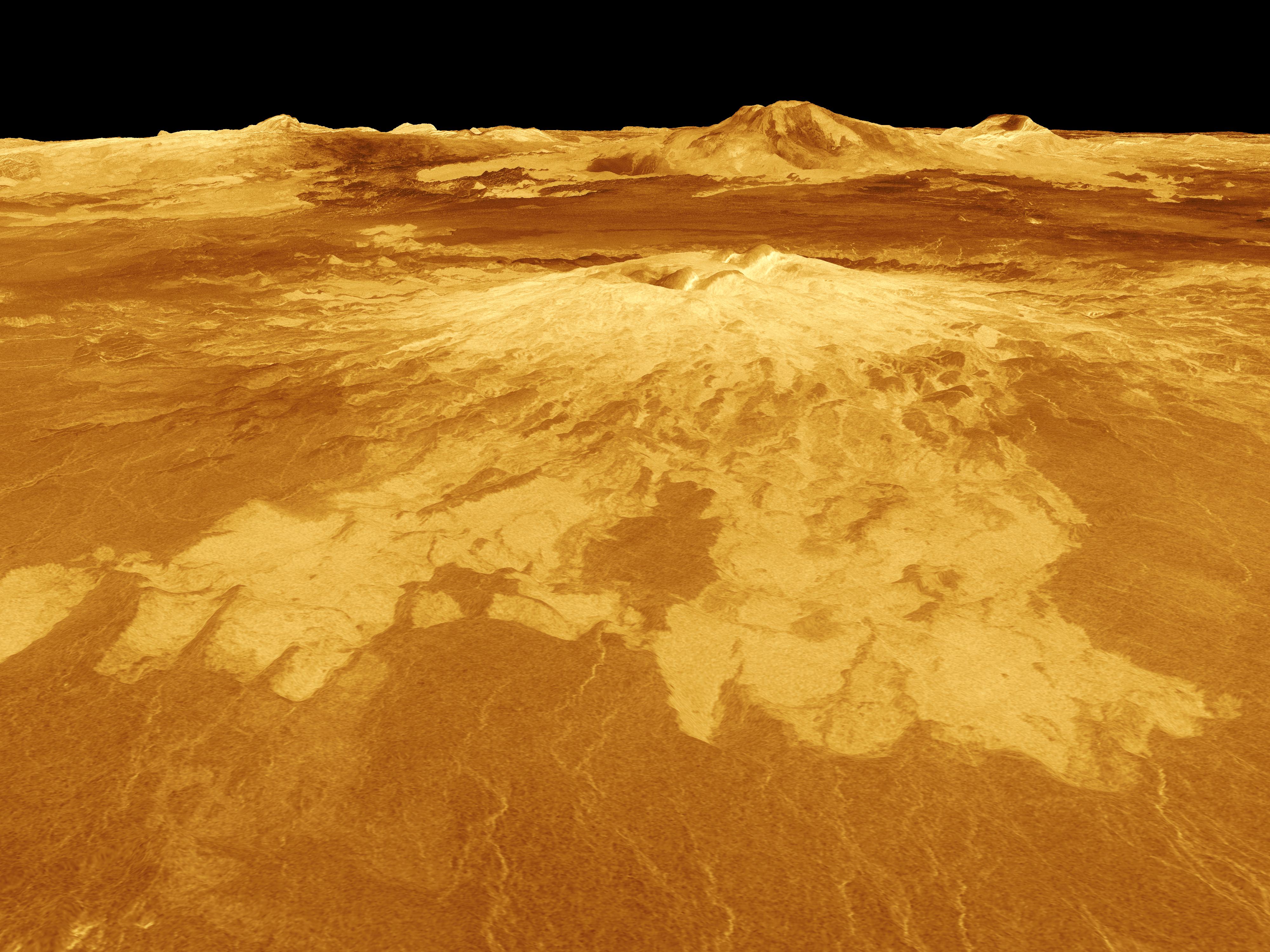
Magellan radar reconstruction. NASA / JPL. The ground beneath the brightness. Not a photograph.
Travel beneath the brightness
The world behind the light
Earth’s twin is a question, not a settled identity.
Venus is Earth’s nearest twin in size, mass, and rock. It formed in the same disk. Then the air stayed, the water left, and the greenhouse ran to completion. Similarity of size did not guarantee similarity of fate.
464 °C
NASA mean. Night as hot as day. Lead melts.
Surface pressure
92 bar
About 900 m beneath Earth’s seas.
Sidereal rotation
−243.02 d
Retrograde. A day longer than a year.
Air
96.5% CO₂
Sulfuric-acid cloud deck 48 to 70 km.
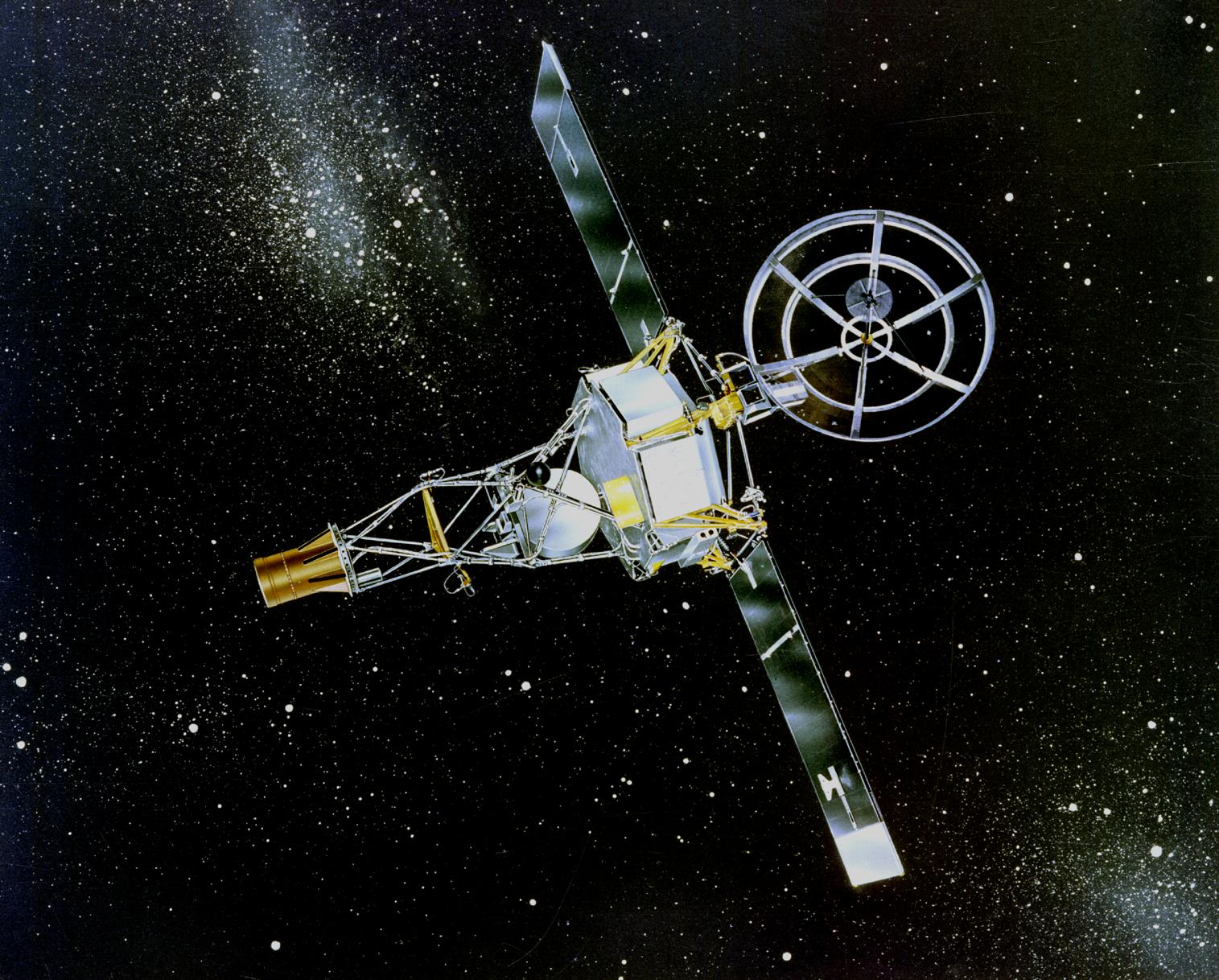
Artist’s concept. NASA / JPL. PIA04594. Mariner 2 carried no cameras. Not a photograph of Venus.
Recorded · how the heat first became news
42 min
Mariner 2 · 14 December 1962
First successful planetary encounter. The radiometers scanned the night side, the terminator, and the day side for forty-two minutes. Night as hot as day is not a later slogan. It is what those minutes returned. A furnace, not a jungle.
Measured · a peer in size
Mean radius
6,051.8 km
NASA / IAU. Not a failed Earth: a peer in size.
Mass
0.815 M⊕
Same rocky family. Different later weather.
Gravity
8.87 m/s²
A body would weigh nearly what it weighs here.
Bulk density
5.24 g/cm³
Consistent with a metal-rock interior.
Bond albedo
~0.77
Clouds send most sunlight back. Brightness is a veil.
Same world · different light
The world does not change. The instrument changes what can be seen. Size was similar. Fate was not.
Documentary · Visible
A crescent of cloud. Almost nothing but light. Sulfuric deck, nearly featureless to the unaided and ordinary camera. The first Venus is an apparition.
Galileo / NASA, 1990. PIA00107.
What this can show
Phase, brightness, the lid.
What this cannot
The ground. Weather inside the deck. A name for what the clouds hide.
Processed science · Parker Solar Probe WISPR, February 2021. NASA / Johns Hopkins APL / NRL. Nightside surface glow and an oxygen halo. Not a metaphor. The original is a narrow nightside strip. It is shown, not stretched.
Measured · The planet that glows
Darkness was not absence of information.
On the nightside, two lights that are not the Sun. The surface, at about 464 °C, is hot enough to shine in visible and near-infrared wavelengths. Parker Solar Probe’s WISPR camera recorded that forge-glow and, around the limb, a halo of oxygen atoms emitting as they recombine. ESA’s Venus Express watched related nightside airglow from orbit. Neither glow is a metaphor. Both are chemistry and heat.
The halo is atmosphere. The disk-glow is rock. Do not collapse them into one pretty ring. Darkness was not absence of information.
Measured · The atmosphere that overtakes its world
What makes an atmosphere run ahead of the world beneath it?
The solid body turns once in about 243 Earth days, and backward. The cloud-top winds can race around in about four days, hundreds of kilometers an hour. ESA’s Venus Express recorded polar vortices whose shapes shift: an S, an eye, a spiral, a figure-eight. The air does not wait for the ground.
Superrotation is measured weather, not a spiritual spin. Keep the four-day cloud circuit distinct from the 243-day sidereal day.
Ground
−243.02 d
One retrograde turn of the rock.
Air
~4 d
One circuit of the cloud tops.
One turn each. In the time the ground turns once, the air has gone around about sixty times.